In the demanding arena of today's serious oversteer competition, victory is not merely solely a function of sheer engine power or driver bravado. Conversely, it has evolved into a complex science which requires a scrupulous blend of choosing a proven car, outfitting it with the highest-quality competition parts, and, most importantly, grasping its dynamic behavior on the course through sophisticated vehicle dynamics analysis tools. This exhaustive manual acts as your roadmap starting from the very first concept of a competition vehicle right through to the final engineering-refined tweaks that transform a capable machine into a repeatable podium finisher. We will examine in detail the art and science of chassis dynamics adjustment, illustrating how a modern vehicle dynamics tool like GripDial removes guesswork and delivers unmatched clarity into your chassis's actual behavior.
The bedrock of any great drift car is, undoubtedly, the chassis itself. A select group of cars have achieved renowned status within the global oversteer culture due to their built-in handling characteristics, robust design, and the enormous availability of specialist components available. Choosing the correct car is the first and most crucial decision a driver will make. As an example, the BMW E36 is commonly accepted as among the best balanced drift cars of the modern era. Its near-perfect 50/50 weight distribution, combined with a rear-wheel-drive layout and extremely reliable six-cylinder powerplants, forms a chassis that is simultaneously easy to handle for novices and incredibly capable in the hands of a pro competitor. The evolution of this concept, the BMW E46, improves on these qualities with a even more refined structure, increased wheel track for greater confidence, and even a greater degree of turning capability straight from the manufacturer. A different dominant option in the top-level scene is the Chevrolet Corvette C6.
This V8-powered performance car offers a particular combination of advantages to the sideways sport, featuring a lightweight aluminum structure, a rear-mounted gearbox and differential unit that aids in an ideal front-to-rear mass ratio, and the tremendous low-end power of a powerful LS-series V8 engine. This combination makes it an absolute weapon on track, capable of initiating and maintaining continuous angles with relatively easy application of acceleration. For those desiring exceptional performance per dollar, the Nissan Z33 rises above as a top-tier choice. It is delivered from the factory with a rigid platform, a decent OEM LSD, and the responsive V6 motor that provides plenty of horsepower and torque for learning and advancing in the activity. Its successor, the Nissan Z34, presents more improvements in chassis stiffness, steering geometry, and outright powerplant performance, establishing its place as a common choice among serious competitors. Additional iconic cars that merit consideration encompass the nimble Wankel-engined Mazda FC, the most popular Nissan S13 240SX, the torque-rich SN95 generation Mustang, the more recent BMW E90, and the compact yet surprisingly fun and teachable Mazda Miata. Each of these platforms provides a different set of characteristics, difficulties, and capabilities, but they all share the basic components required to become a competitive drift car.
However, selecting the optimal platform is only the first step. To access the complete performance of every of these machines, major changes to the steering geometry and chassis control systems are utterly mandatory. This is where the realm of performance drift-spec components becomes critical focus. The most most impactful upgrade for a purpose-built drift machine is the installation of a drift-spec angle modification kit. These sophisticated assemblies, for example those developed by performance brands like SLR Speed, are designed to dramatically increase the car's maximum steering angle. A OEM production vehicle is severely restricted in how far its front wheels can rotate, a safety trade-off for daily use. In oversteer driving, however, maximum countersteering is continuously required to control and sustain a angle. An angle kit substitutes the OEM hubs, tie rods, and potentially A-arms with pieces that permit the steered wheels to reach steering lock beyond 70 or even 80 °, versus a typical stock angle of around 40 to 50 degrees.
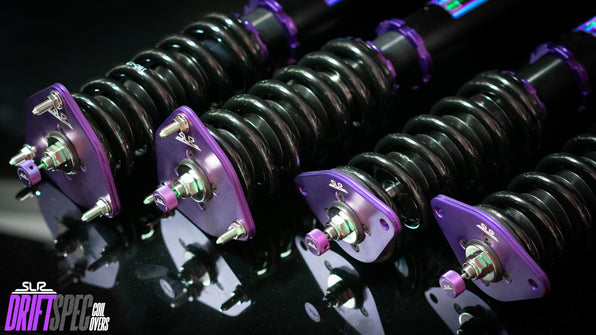
This immensely greater steering angle provides the driver with exponentially more command during a slide, making it much simpler to begin a slide, maintain it through a extended bend, and transition fluidly from one side to the other. The improvement in drivability is absolutely revolutionary. Coupled with a correctly chosen angle kit is the just as essential enhancement to the vehicle's damping system. Generic or even premium road dampers are simply not designed for the unique and brutal demands of drifting. A dedicated set of adjustable dampers is of utmost importance. These specific dampers have unique piston tuning and spring strength that are optimized for the violent weight transfer that is characteristic of drifting. When a pilot starts a drift, the vehicle's mass is shifted rapidly to the outer of the turn. Correct drift-spec coilovers handle this movement in a consistent manner, permitting the car to stabilize quickly and offering the operator precise feedback through the controls and driver's seat. They also provide accurate tuning of ground clearance, shock absorber rate, and weight balance, which are all key parts of optimizing the car's handling to a given track or competition technique. Together, a top-tier steering angle kit and a expertly selected set of competition coilovers constitute the absolute physical foundation upon which all later refinement is constructed.
Once the fundamental parts is in place, the next vital stage in the development is the precise tuning of the vehicle's wheel angles. This is the realm of car suspension tuning, a procedure that can feel daunting to the beginner but is, in reality, the secret to turning a collection of high-performance pieces into a harmonious and predictable vehicle. The most discussed parameter of alignment for sliding is definitely camber. Camber angle is the inclination of the rim relative to the upright plane when looked at from the front of the vehicle. When the upper part of the tire is angled inward, this is called camber-in. In oversteer driving, negative camber on the front wheels is generally applied and is seen as critical. The purpose is car alignment tuning fundamentally tied to vehicle dynamics.
When a car is turning at high slip angles, the chassis leans to the external of the bend. This lean forces the outer front wheel to diminish its best grip area with the asphalt. By applying negative camber, the wheel is pre-leaned to compensate for this roll. As the car leans into the corner, the outside front tire flattens out against the asphalt, optimizing its bite at the exact time when it is most required for control. Typically, front axle adjustments for a serious drift machine range from approximately -3 degrees to as much as -5 degrees or even beyond, contingent on the details of the chassis geometry, compound selection, and operator style. The rear wheels also utilize negative camber, but the values are generally less and less aggressive than the front. Overly aggressive negative camber at the back can result in the chassis excessively loose and difficult to control on power input, as it shrinks the available contact patch of the driving wheels during forward power delivery. Thus, rear axle adjustments are often in the vicinity of -1 degree to -3 degrees, finding a precise balance between offering enough cornering bite to assist in initiating and maintaining the angle while simultaneously preserving effective hook-up for exiting the turn. Camber is merely one component of the broader alignment puzzle, which additionally involves toe, caster, and bump steer adjustment.
Toe refers to the orientation of the tires when viewed from above. Positive toe means the leading edges of the wheels are closer together than the trailing edges, while negative toe means the reverse. For drifting, a modest amount of front axle toe out is frequently employed to quicken the initial response steering feel, making the chassis feel more responsive and willing to initiate a oversteer moment. Rear toe angle is usually set to neutral or a extremely slight amount of inward toe to foster straight-line stability under power. Caster is the longitudinal or backwards tilt of the kingpin axis when viewed from the side-on of the chassis. More positive caster increases steering feel and high-velocity solidity, and it additionally boosts inward lean gain during steering, which is highly advantageous. Setting these settings is a detailed interplay where a adjustment to one value can and will affect the remaining parameters. The conventional approach for setting a car's suspension geometry for competition has for a long time been a time-consuming process of trial and error. A pilot or engineering group would introduce a adjustment based on a hunch, drive the car on track, use the operator's subjective feel and comments, and then apply an additional tweak. This cycle would repeat time after time until the chassis felt "acceptable" or the allotted practice session was exhausted. This methodology is not only extremely inefficient in terms of time and costs, but it is furthermore inherently imprecise.
Pilot perception is a notoriously subjective measurement tool, affected by numerous variables such as fatigue, changing track grip levels, temperature, and simply the mindset of the operator on that specific session. What feels "oversteery" on one lap might feel "pushing" on the next run, causing conflicting feedback and frustrating tweaks. This long-standing problem in vehicle dynamics optimization is exactly where contemporary telemetry systems has made its mark to completely change the methodology.
The advent and application of specialized drift telemetry software has ushered in a radically different age for engineering and optimizing high-performance drift machines. These platforms, represented by groundbreaking systems like data acquisition tools, work by directly recording the live dynamic movement of the chassis as it is operated on the track. As opposed to depending on driver impression, these devices collect measurable data on critical parameters such as damper compression and extension, individual tire rotation, lateral and longitudinal g-forces, wheel angle, and driver input application. This raw information flow is then interpreted by powerful algorithms that can graph and decode the metrics in a actionable manner. For the very first time, drivers and teams can observe precisely what the chassis is doing at any given point of a drift. This capability transforms the whole chassis setup process. Think about the particular task of setting the front axle negative camber for a given car. Instead of making a change from -3 degrees to -3.5 degrees and then testing multiple laps to try and "feel" a improvement, a telemetry system can provide real-time and clear feedback. The application can show in a chart how the suspension's contact patch is acting during the key moments of a drift: turn-in, holding the angle, and changing direction. It can demonstrate if the existing angle is permitting the outside front tire to keep ideal loading or if the tire is over-stressed on its external shoulder.
The system can subsequently make data-driven advice for modification. Perhaps the information indicates that the tire is even overloading its edge at -3.5 degrees of camber, implying that a move towards inward lean, say -4 degrees, might be warranted. On the other hand, the data might show that the tire is failing to achieving temperature or that the inner shoulder is degrading too quickly, which could point to that there is excessive angle and a modest reduction back to -3.2 degrees would be more optimal. This standard of accuracy and actionable insight was simply impossible in the time of exclusively seat-of-the-pants adjustment.
The impact of employing a advanced drift telemetry system goes well beyond just optimizing alignment. It becomes an essential damper adjustment manual that is customized to your exact vehicle. When adjusting the shock absorber clickers on your adjustable dampers, instead of using imprecise advice or replicating another driver's settings, you can employ the data to observe how the chassis is performing in response to your tweaks. The tool can graph the wheel movement trace over a section of track, highlighting if the shocks are controlling the chassis motion properly or if they are causing the vehicle to bounce too much after a direction change. It can assist in identifying issues like bottoming out or topping out, enabling you to introduce educated decisions to spring preload, rebound/compression rates, or ground clearance. This process applies just as well to the complex process of corner balancing. Beyond camber, drift telemetry software the system can give insight into how modifications to toe settings and caster are impacting the vehicle's balance during different parts of a slide. For instance, it can assist you to find the optimal amount of front axle negative toe for your particular steering configuration and competition style by showing the response time of initial response and the stability of the car at lock steering angle. This makes the tool an extremely useful performance optimization handbook that is actively informed by the real-world dynamics of your specific car on the track. It shifts the complete endeavor from a subjective skill into a repeatable engineering process.
Moreover, the value of a platform like modern telemetry is in no way confined to experienced engineers with extensive resources. For the club-level competitor, it functions as an amazing equalizer. It in essence offers the tuner with the insight of a expert dynamics engineer without needing the associated overhead. It speeds up the learning curve by providing definitive solutions to questions that would otherwise take years of experience to understand. A builder can understand how their individual vehicle responds to different adjustments, gaining a more intuitive knowledge of suspension theory in the endeavor. It furthermore opens up high-level chassis dynamics concepts, allowing anyone with the desire to refine their vehicle to do so in a systematic and productive way. This is particularly significant in a activity like sliding, where setup knowledge has in the past been a highly secretive commodity among top teams. Today, that power can be in the toolkit of every dedicated builder.
In summary, the process to engineering and tuning the ideal championship-contending sliding vehicle is a multi-faceted endeavor that smoothly blends classic engineering wisdom with revolutionary telemetry technology. It commences with the wise selection of a legendary chassis, then enhanced by the application of critical competition components like high-performance drift angle kits and correctly selected performance adjustable dampers. The journey then moves into the detailed stage of chassis car alignment tuning dynamics adjustment, where settings like camber, toe setting, and caster angle are precisely adjusted to suit the vehicle's new geometry and the driver's individual technique. The final step, and what genuinely distinguishes the today's approach from the traditional methods, is the integration of a powerful suspension tuning application. This platform eradicates the guesswork and inefficiency of solely seat-of-the-pants adjustment by delivering objective, actual information on how the chassis is really performing. It acts as an incredible suspension tuning tool, a actionable coilover setup manual, and a comprehensive performance analyzer. In unison, this complete approach guarantees that each and every aspect of the drift machine—from the choice of the platform to the final click on the damper—is refined for maximum performance on the track. It represents the total evolution of the sport of drifting, connecting mechanical pilot talent with data-informed vehicle setup to build the ultimate dominant cars imaginable.